
First ask: who starts the muscle contraction?
A conventional pelvic floor exercise is an action you attempt yourself: gently contract the relevant muscles, then let them release completely. Learning both halves matters. A feedback device may display a signal while you practice, but the signal is not the movement itself. Body position and pressure against a sensor can also affect a reading; a rising graph does not prove that you isolated the right muscles.
BTL describes its EMSELLA as a chair that uses a high-intensity focused electromagnetic field to induce pelvic floor contractions. That is a different mechanism from a seat that observes your voluntary effort. Some electrical stimulation devices use current delivered through electrodes or a probe; these are a third category. A warm or vibrating cushion might feel soothing but does not, by warmth or vibration alone, demonstrate that a strengthening contraction occurred. The word chair describes furniture, not a treatment mechanism.
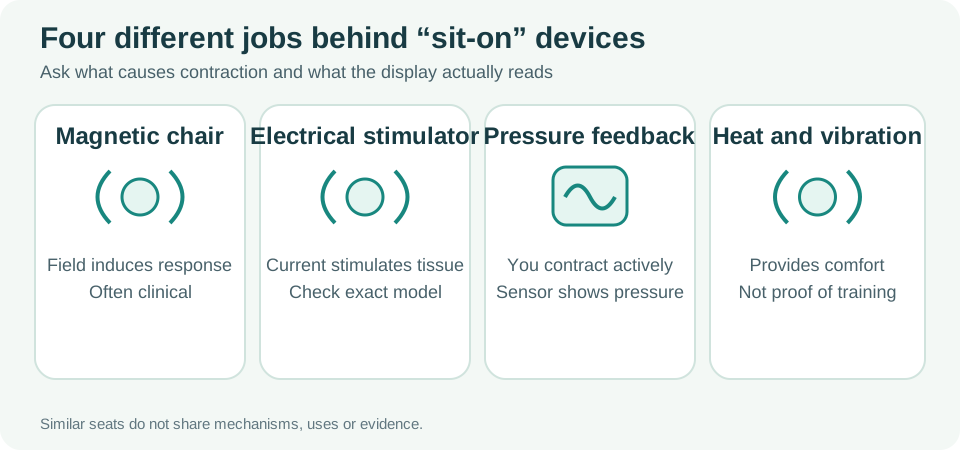
Use this four-question shopping test
| Question | What to look for |
|---|---|
| What produces the contraction? | Your own effort, a magnetic field, an electrical current, or no claimed contraction at all? |
| What does the display measure? | An actual sensor signal, session time, or merely a preset program? Ask what movements can change the reading. |
| Where is it meant to be used? | A clinician's office, a supervised program, or ordinary home use? |
| What evidence belongs to this exact model? | Check the model number, intended use, instructions, and studies. Evidence for a different model or mechanism does not transfer automatically. |
The last question protects you from a surprisingly common shortcut: a seller points to a paper about a magnetic clinic chair, then offers a home pressure seat as though the study covered both. A US FDA document for the BTL HPM-6000UF describes a magnetic coil built into a chair and prescription use. It does not certify every product marketed as a Kegel chair, and it tells you nothing about the effectiveness of an unrelated home seat.
Which experience are you actually buying?
If a clinician recommends a particular treatment because you cannot identify or contract the muscles, ask about that treatment's mechanism and supervision. A home feedback trainer may be useful for someone already able to practice an active contraction who wants a more structured routine. These are different starting points. Also consider comfort and privacy: a “sit-on” format can be appealing, yet it should not override what your symptoms call for.
If exercise consistently increases pelvic pain, urgency, or a feeling of gripping, more contractions may be the wrong next step. A pelvic health professional can assess whether coordination, relaxation, or a different approach needs attention. No shopping table can make that assessment for you.
Where HOSFU Gen4 fits
HOSFU Gen4 is a fully clothed, sit-on active practice option: in its guided mode, you contract and fully relax while its air cushion shows pressure changes. Its separate quick mode offers gentle heat and vibration for comfort without asking you to contract. It is not a magnetic stimulation chair, an electrical stimulator, or a substitute for care recommended by your clinician. If active home practice is what you are seeking, see the Gen4 product details.