
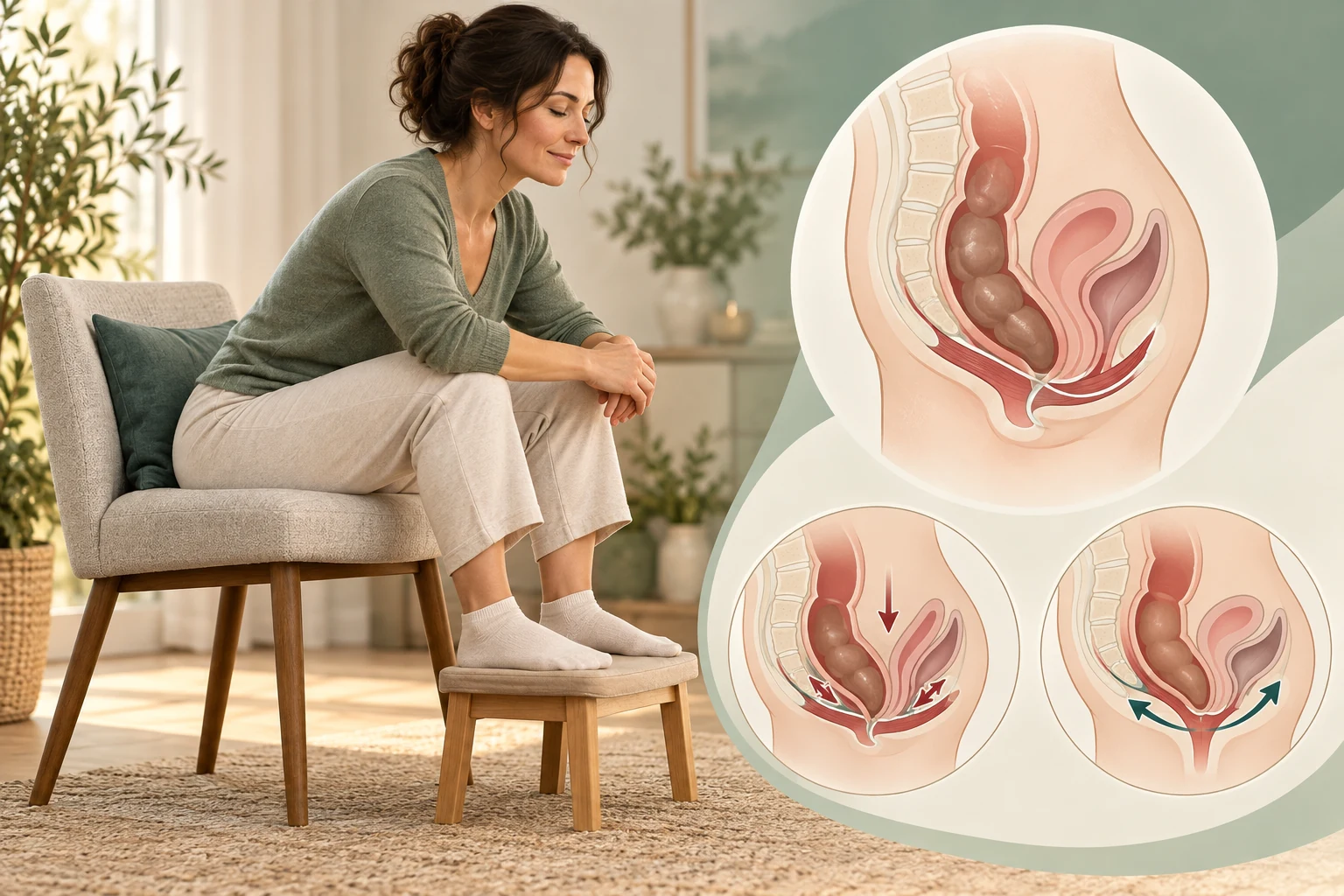
Work on the load as well as the lift
A rectocele—also called posterior vaginal wall prolapse—happens when the rectum bulges toward the vagina because the tissue between them has weakened. Exercise may improve support and symptoms, especially in a mild case, but it does not simply “pull every prolapse back into place.” The size of the prolapse and how much it affects daily life matter.
Pelvic floor training is one part of conservative care. Bowel consistency and toilet mechanics can matter just as much because repeated straining keeps pushing pressure toward the weakened wall.
Try this sequence:
1. Put your feet on a small stool so your knees sit higher than your hips. 2. Lean forward with a long spine and rest your forearms on your thighs. 3. Let your belly soften and breathe out instead of holding your breath. 4. Avoid repeated hard pushing. If nothing happens, pause rather than turning one visit into a strength test.
Discuss fiber, fluid and constipation treatment with a clinician, especially if you have other health conditions or take medicines that affect bowel function.
What should a training plan include?
| Training may help with | Training cannot decide alone |
|---|---|
| Better muscular support and timing | The type and degree of prolapse |
| Fewer symptoms during some daily tasks | Whether a pessary or surgery suits you |
| Confidence managing pressure | Why bowel emptying is difficult |
A useful plan checks whether you can both lift and release the pelvic floor. Strength without relaxation can make emptying more difficult. Training should also connect to daily pressure: exhale when lifting, manage cough, and reduce loads that reliably worsen heaviness.
A urogynecologist or pelvic health therapist can assess the prolapse and teach technique. Other nonsurgical options may include a fitted pessary. Seek prompt medical care for severe pain, bleeding, an inability to pass stool or gas, vomiting, or tissue that becomes acutely swollen or discolored.
If a clinician recommends active pelvic floor strengthening, HOSFU Gen4 can support fully clothed seated practice with feedback. It cannot diagnose or grade a rectocele, and it does not replace constipation care or a pessary discussion.