
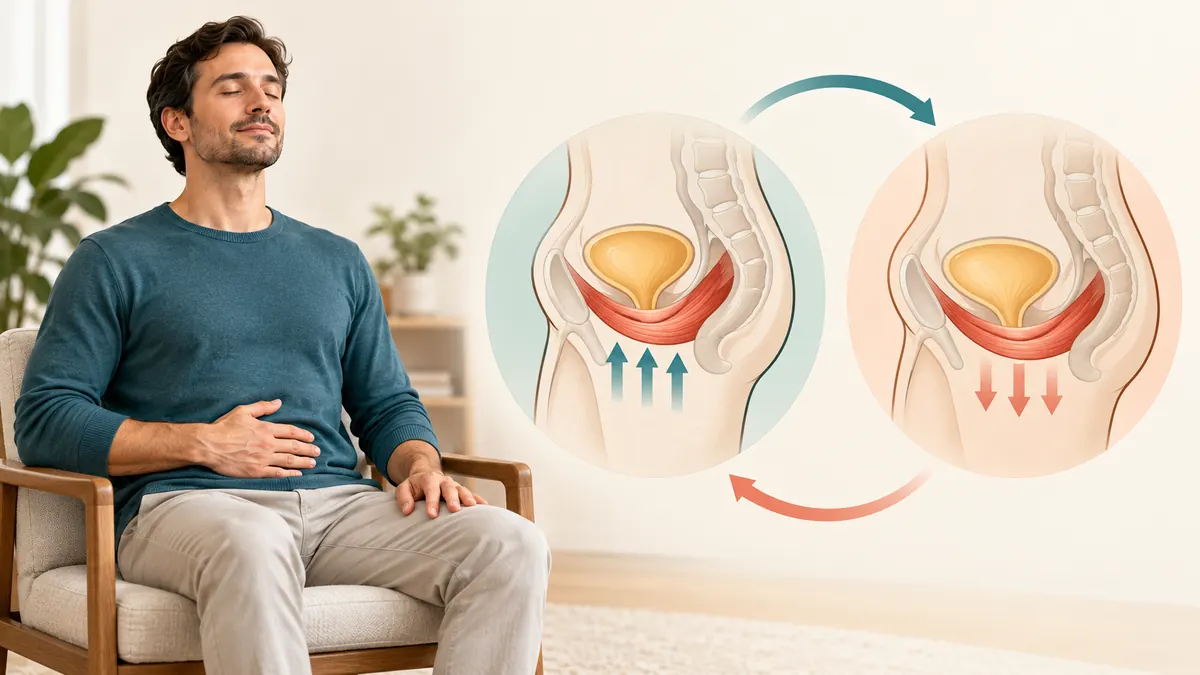
What is the male pelvic floor?
Picture a car with both an accelerator and a brake. A stronger accelerator is not helpful if the brake is stuck, and a better brake is not the only answer if the engine has a different problem. Your pelvic floor also needs two abilities: it must contract when needed and relax when needed. A sensible training plan addresses both.
The pelvic floor is a hammock of muscles at the base of the pelvis. It supports the bladder and bowel and participates in urinary control and sexual function. You may notice it when you gently stop gas from passing. The muscles should then release fully.
NIDDK describes Kegel exercises as a way to strengthen these muscles, particularly for bladder control. Correct technique matters. A hard squeeze that pulls in the abdomen, buttocks, and thighs is not necessarily good pelvic floor training. Nor is holding the muscles tight all day.
Can Kegels help you last longer in bed?
Some people benefit from better pelvic floor awareness and coordination. Research into pelvic floor rehabilitation for premature ejaculation is promising but limited; it does not prove that a home device or a fixed routine will work for every man. Premature ejaculation can also involve anxiety, erectile difficulties, medication effects, and other health factors. The right approach depends on the pattern and on what matters to you and your partner.
The phrase “last longer” is also not a diagnosis. If ejaculation timing is causing distress, a clinician can help discuss behavioral strategies, pelvic floor therapy, and medical treatments. If your issue is reduced erection firmness, pain, or loss of sensation, a different assessment may be needed.
How to find the muscles without creating bad habits
You can identify the pelvic floor by gently imagining that you are preventing gas. You may feel a slight lift under the pelvis. Then let go completely. NIDDK advises against regularly interrupting urine flow to practice, because doing so can interfere with normal bladder emptying.
Your breathing is a useful gauge. If you have to hold your breath to make the contraction happen, reduce the effort. A pelvic floor contraction should feel controlled, not like lifting the heaviest weight at the gym.
A balanced male Kegel routine
If strengthening is appropriate and the exercise is comfortable, start with a few gentle contractions in a supported position. Contract, breathe, and release fully. As control improves, you may practice in sitting and standing, where the muscles meet different everyday demands. A pelvic floor therapist can set the hold time, rest time, and frequency for your situation.
There are two common training ideas:
• Controlled holds teach you to contract and maintain a gentle effort without recruiting every nearby muscle.
• Brief contractions train quick engagement, followed by an equally clear release.
Neither is a race for the most repetitions. If the muscle cannot return to rest between contractions, the session may become like repeatedly clenching your fist without opening your hand. Quality falls even while the count rises.
What are reverse Kegels for men?
“Reverse Kegel” usually refers to a gentle pelvic floor relaxation or lengthening cue. It is not a forceful push. Think of lowering a drawbridge slowly, rather than shoving it downward. During a calm inhale, you may notice the pelvic floor soften. You should not strain or bear down hard.
Relaxation work can be relevant when muscles are overactive or difficult to release, but the label alone cannot diagnose that problem. If you have pelvic pain, urinary urgency, constipation, or pain after ejaculation, ask a pelvic floor clinician to evaluate you. Simply adding more strengthening to an already guarded system may worsen discomfort.
Breathing and arousal awareness
Breathing is not a magic switch for ejaculation. It can, however, help you notice tension. When arousal rises, some men unconsciously brace the abdomen, jaw, and pelvic floor. A slower exhale and a deliberate release may help reduce unnecessary gripping. That skill takes practice away from the pressure of sex.
Another useful analogy is a volume knob. It is easier to make a small adjustment when you notice the volume at six than when it has already reached ten. Learning your own arousal cues, taking pauses, and communicating with a partner can be more useful than trying to squeeze your way through the final moment.
Common mistakes
Squeezing during every sexual moment. Constant clenching can increase fatigue and make it harder to distinguish a useful contraction from background tension.
Training through pain. Pain is a reason to pause and ask what is happening, not proof that the workout is effective.
Ignoring other causes. Erection changes, medication, stress, and relationship context can all matter. Pelvic floor exercises are one part of a broader conversation.
Expecting an instant result. Muscle learning takes time. Even when pelvic floor therapy is helpful, improvement may require individualized instruction and other care.
When to get professional help
Seek medical advice if ejaculation concerns persist or cause distress, or if you have pelvic pain, blood in urine or semen, urinary symptoms, new erectile difficulties, or numbness. A clinician can determine whether pelvic floor training fits the situation. For persistent premature ejaculation, treatment may include behavioral and medical options; pelvic floor rehabilitation is one possible approach, not the only one.
Where HOSFU fits
HOSFU can support guided pelvic floor practice for people who have been advised to train these muscles. It cannot diagnose why you ejaculate sooner than you want, and no device can promise a specific duration of sex. The most useful measure of progress is better awareness and control without pain or constant clenching. If symptoms suggest an overactive pelvic floor, get advice on relaxation and appropriate exercise before starting a strengthening routine.
A good pelvic floor behaves less like a permanently tightened belt and more like a responsive hand: it grips when needed, then opens. That flexibility is the real training target.
How often should men do Kegels?
There is no single schedule for every person. Start with correct, comfortable contractions and full relaxation, then use a plan from a clinician or pelvic floor therapist if you have symptoms.
Should I do reverse Kegels instead of regular Kegels?
That depends on whether you need strength, relaxation, coordination, or treatment for another issue. A professional assessment is more useful than choosing from the label alone.
Are pelvic floor exercises a cure for premature ejaculation?
No guaranteed cure exists. Pelvic floor rehabilitation may help some men, while others need different or combined approaches.