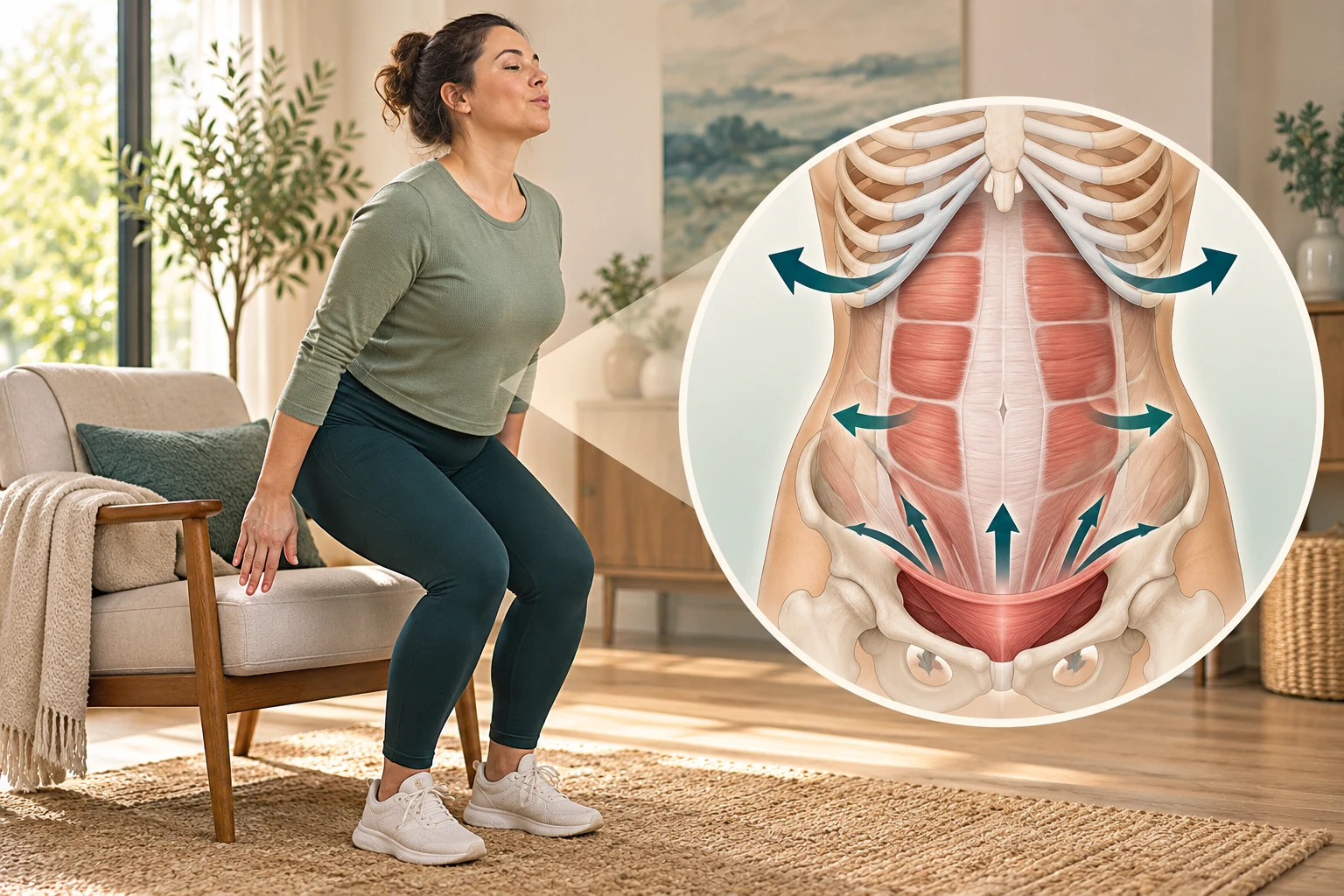

Pregnancy and surgery affect the same pressure team
That does not mean every person needs months of treatment. It means the birth route alone cannot answer the question.
Your diaphragm, abdominal wall and pelvic floor work like the top, sides and bottom of a soft canister. When you breathe, cough, stand or lift the baby, pressure moves through the whole container. Pregnancy changes that system before labor begins. After surgery, pain and guarding may make you hold your breath, move stiffly or avoid using the abdominal wall.
A pelvic health physical therapist can look at more than strength: bladder and bowel control, breathing, scar mobility after healing, abdominal coordination, pelvic heaviness and the return to lifting or exercise.
Use symptoms, not the incision, as your checklist
| What you notice | Useful next step |
|---|---|
| No symptoms and steady recovery | Follow your maternity team’s gradual activity plan and practice gentle pelvic floor coordination |
| Leakage, urgency or trouble emptying | Record when it happens and request a pelvic health assessment |
| Heaviness, pressure or a bulge sensation | Reduce activities that worsen it and seek assessment |
| Scar pain, pulling or abdominal doming | Ask about wound healing and coordinated abdominal rehabilitation |
| Pain with sex or a pelvic floor that never seems to release | Do not solve it with harder Kegels; ask for relaxation and coordination assessment |
Start with a quiet reconnection
If your care team has not given different instructions, wait until any urinary catheter is removed and you are passing urine normally. In a comfortable lying or side-lying position, breathe into the lower ribs. On an easy exhale, gently close and lift the pelvic floor. On the next inhale, release fully.
Two or three comfortable repetitions are enough to check the connection. This is closer to testing the lights after a power cut than starting a gym session. Stop if pain, bleeding, downward pressure or other symptoms increase.
Returning to impact exercise and heavy lifting follows a different timeline from gentle pelvic floor work. Your surgeon’s restrictions and your individual recovery come first. Seek urgent care for heavy bleeding, fever, worsening wound redness or discharge, chest pain, breathing difficulty, calf swelling, inability to urinate or severe new pain.
You do not need pelvic floor therapy simply because you had a C-section. You may benefit from it when symptoms, uncertainty or a difficult return to daily tasks show that the pressure team is no longer working together smoothly.
Once a clinician confirms that active strengthening fits your recovery, HOSFU Gen4 can make fully clothed seated practice easier to follow with feedback. It does not assess a C-section scar or determine when you are ready for exercise.