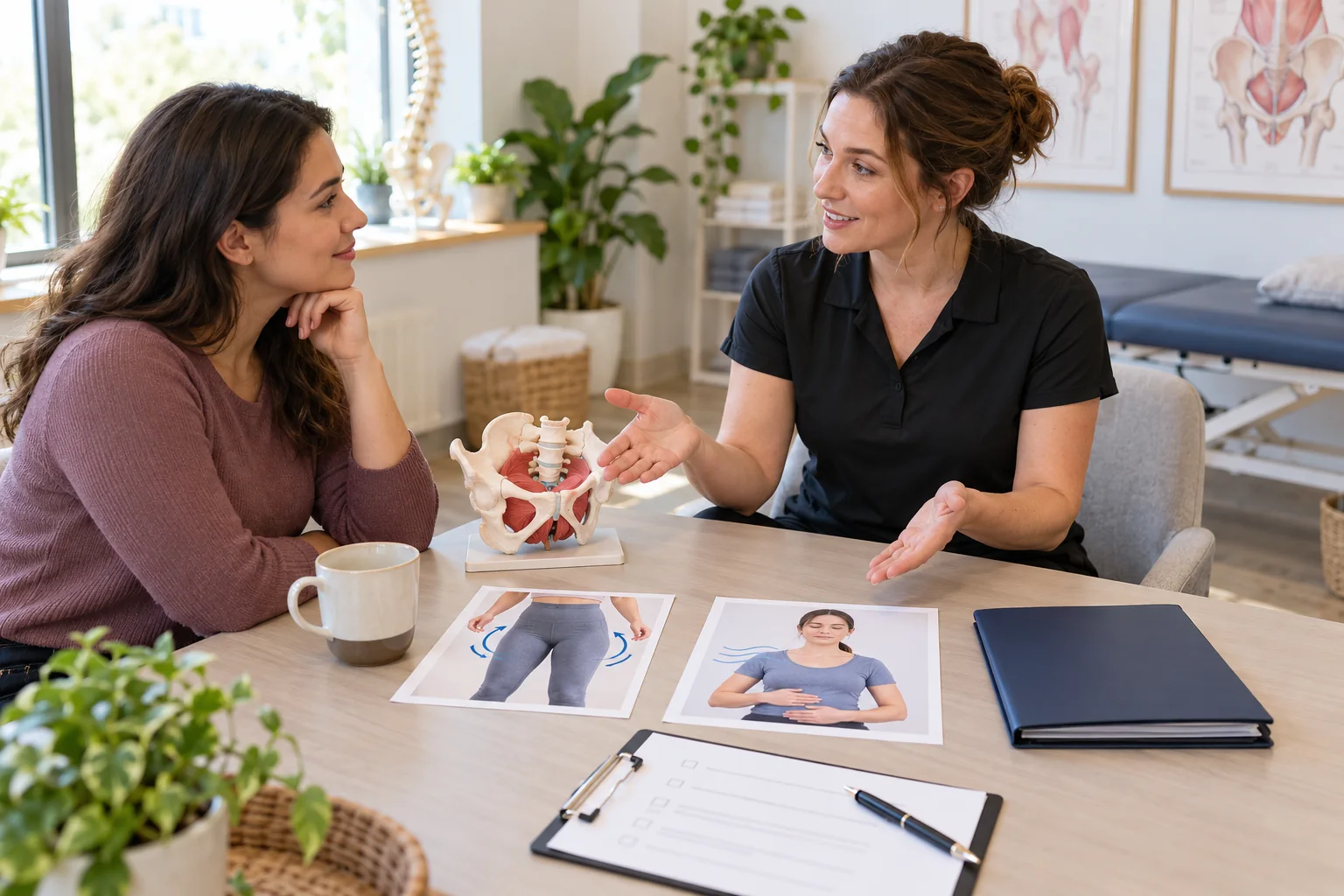
Break the word “massage” into three jobs
Pelvic floor massage is not one fixed move, and it is not an attempt to “press the pain out.” In pelvic rehabilitation it may mean external soft-tissue work, breathing and movement, or—after clear consent—an internal assessment. The choice should follow your symptoms, the examination and your preferences.
The first job is understanding. A therapist may ask where discomfort occurs, when it begins, whether bladder, bowel or sexual function has changed, and what makes it better or worse. The second is external assessment. Breathing, hip and back movement, the abdomen, buttocks, inner thighs and tissues around the perineum can all offer clues. An internal assessment or treatment is a possible third step, not a compulsory event at a first visit.
At any point you can ask: “What will this step tell us?” “Is there an external option?” “Can we pause?” Consent is not a day pass handed over at reception. It works more like a light switch in the room: you can turn it off at any time.
Pain is not proof that the therapist found the right spot
| What you notice | A useful question | A conclusion to avoid |
|---|---|---|
| Perineal tightness after sitting | Could posture, breathing or muscle tension contribute? | “There must be one knot to crush” |
| Pain with sex or bowel movements | Do coordination and relaxation need assessment? | “More Kegels will fix it” |
| External touch is already uncomfortable | Can we begin with conversation, breathing and an external exam? | “I have to endure an internal exam” |
A tense muscle can behave like a hand that has been making a fist all day. Forcing the fingers farther apart does not necessarily persuade it to let go. Calm breathing, less guarding and gradual movement may matter more. Skilled treatment changes with your response instead of using pain as a scoreboard.
Stop and tell the clinician if pain becomes sharp or keeps rising, or if you develop numbness, bleeding or a strong sense that your body is bracing against the procedure. Fever, blood in urine, inability to urinate, or sudden severe pelvic or lower-abdominal pain needs prompt medical attention rather than massage.
Home comfort is not a substitute for clinical massage
Warmth, a bath or gentle external relaxation feels soothing for some people, but comfort does not identify a diagnosis. Do not insert an improvised tool, and do not attempt massage with severe pain, signs of infection, unexplained bleeding or before postoperative clearance. If symptoms repeatedly disrupt urination, bowel movements, sex or sleep, write down the trigger and take the pattern to a clinician or pelvic health therapist.
A precise sentence is a useful starting point: “After twenty minutes of sitting, my perineum feels clamped; walking eases it.” That gives a professional more to work with than “my pelvic floor is bad.”
If your established plan includes active contractions followed by complete releases, HOSFU Gen4 offers fully clothed seated pressure feedback plus optional warmth and vibration for comfort. It is not an internal massage tool and does not replace an assessment; use it only as one part of a plan that fits you.