
How can a seat pick up a pelvic floor contraction?
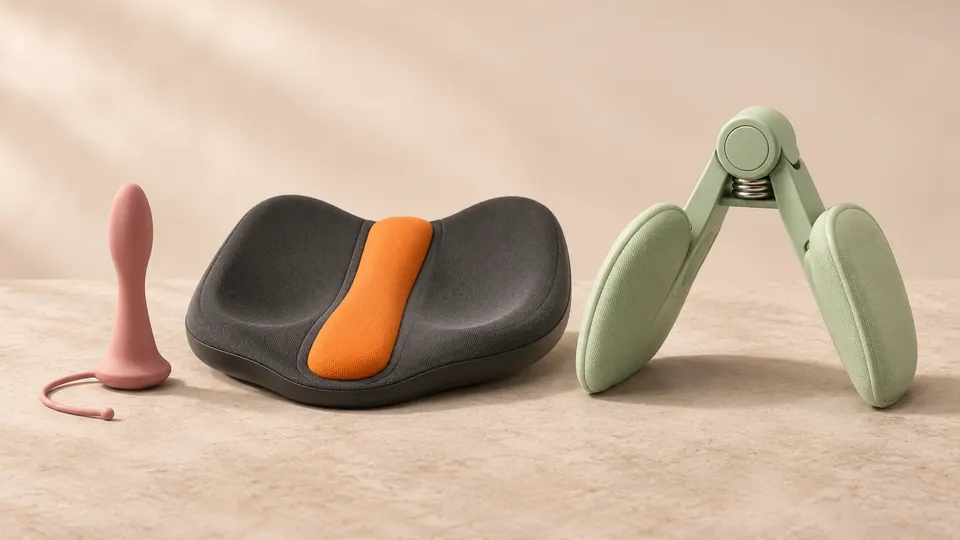
A Kegel involves gently drawing the pelvic floor inward and upward. That lift can move the soft tissue of the perineum, the area between the genitals and the anus. When you sit on Gen4 fully clothed, its central air cushion rests beneath this area. Even a small movement can change how your body presses against the cushion.
In Professional Mode, Gen4 sends the pressure signal to the HOSFU app over Bluetooth. The graph gives you a visual cue that you can compare with the movement you feel. Pressure alone can’t tell you exactly which muscles produced it.
Why do I need to calibrate before I start?
Your weight already puts pressure on the cushion while you’re sitting still. Calibration gives the app a reference for that seat position and cushion inflation. Place Gen4 on a firm, level chair and connect it to the app before you sit down. Once the light is steady blue, sit with the narrow end between your thighs and both feet flat on the floor. Choose a program, then follow its calibration prompts.
If you shift noticeably, move the trainer or change the amount of air in the cushion, recalibrate before continuing. For an app-guided session, choose Professional Mode. Quick Mode provides warmth and vibration and runs independently of the app.
What should I look for as I squeeze, hold and release?
Start with timing. As you gently squeeze and lift, watch when the line changes. Keep breathing through the hold. Then let go and notice whether the line moves back toward where it started. Give yourself time to feel the difference between holding and releasing before the next repetition.
If the line barely moves, check the cushion’s position and the calibration before trying harder. A small change can occur even when your muscles are active. A return to the starting level tells you the pressure has settled, but it can’t confirm that every muscle has fully relaxed.
Why does the line move when I lean forward?
Leaning shifts some of your weight onto a different part of the seat. Pressing down, bracing your abdomen or tightening your buttocks or thighs can also change the load on the cushion. If a spike coincides with reaching for your phone, interpret it in light of that movement.
That’s also why a taller peak today doesn’t establish that you’re stronger than yesterday. For a more useful comparison, keep the chair, position and cushion inflation consistent and look at how the signal changes as you follow each cue.
What have researchers found about seated pressure feedback?
In a 2022 study published in Healthcare, 20 healthy women practiced seated pelvic floor contractions. Ten used an inflatable pressure device under the perineum and ten received verbal guidance. Ultrasound showed greater upward movement of the bladder base in the pressure-feedback group after training and at the one-week check. The small study leaves open how long any benefit lasts.
With that particular device, lifting the pelvic floor could reduce pressure, while bearing down could increase it. The direction of a reading depends on the equipment. The study offers no target height or direction for the Gen4 graph.
How did an external sensor compare with a clinical assessment?
In a 2025 doctoral study at Jagiellonian University Medical College, Dominika Michalik studied 100 women, half with pelvic floor dysfunction and half healthy controls. The research team checked each participant’s ability to contract her pelvic floor using touch and abdominal ultrasound before comparing readings from the external kGoal Boost sensor with three other assessments.
Across participants, higher Boost readings tended to go with higher readings on the other assessments. The correlation was 0.74 with an internal kGoal probe, 0.70 with a perineometer and 0.73 with the Oxford scale, which a clinician uses to grade a contraction by touch. Those numbers describe how measurements varied together. They don’t tell us how often an app recognizes a correct repetition.
Do these studies validate HOSFU Gen4?
Both studies help explain why a sensor outside the body can pick up pressure changes during pelvic floor exercise. Each tested other equipment. Establishing how accurately Gen4 identifies a contraction, measures strength or tracks a clinical improvement would require research on Gen4 itself.
Use the graph as an extra cue during practice. If you’re unsure whether you’re lifting or bearing down, a pelvic health physical therapist can assess your technique. If you have pelvic pain or difficulty emptying your bladder or bowels, ask a healthcare professional whether these exercises are appropriate for you.